
Home › Kings News › APR Games
APR GamesRugby tens explained: the 10-a-side format of the APR Games
Ten players a side, five-man scrums, drop-kick conversions and a two-minute sin bin. Here is how 10s rugby works, how it compares with 15s, sevens and rugby league nines, and how to get ready for the APR Games in Las Vegas.
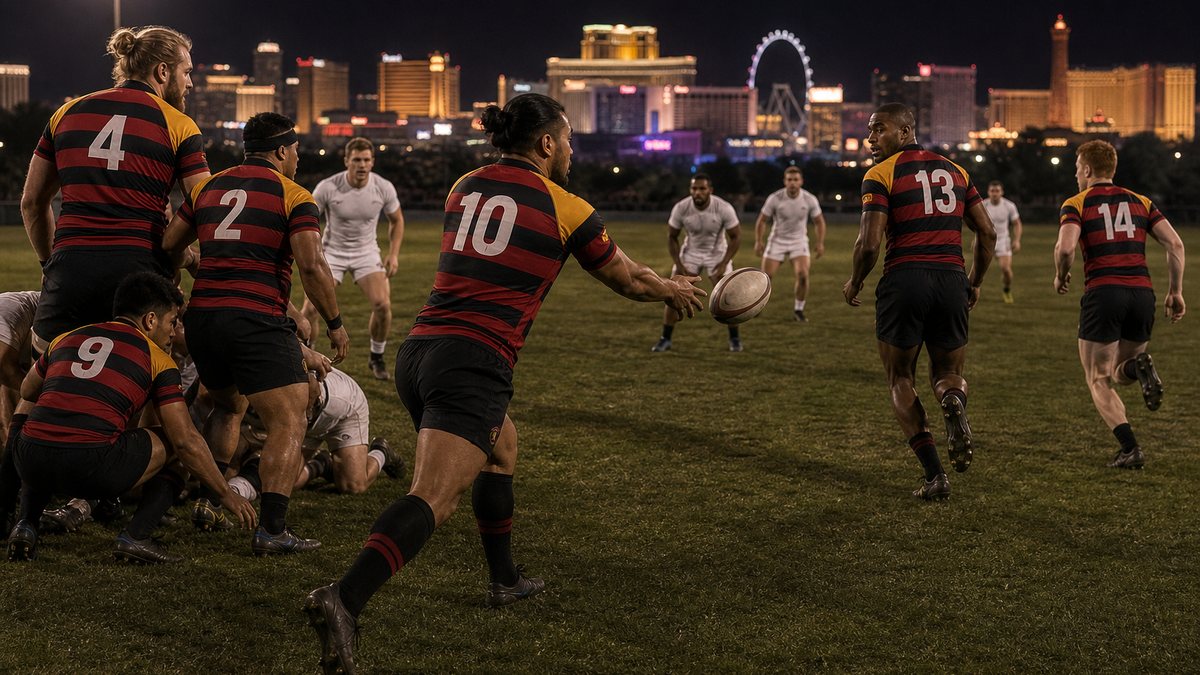
Key facts at a glance
- Players: no more than 10 per team on the field (World Rugby 10s Law 3.1)
- Replacements: up to five, and organizers may vary that number (Laws 3.4 and 3.5)
- Match length: 20 minutes, two halves of no more than 10 minutes, which organizers may vary (Law 5.1)
- Scrum: five players per team in two rows, two props and a hooker in front, two locks behind (Law 19.5)
- Conversions: drop kicks only, within 30 seconds of the try being awarded (Laws 8.7 and 8.8)
- Sin bin: two minutes for a yellow card (Law 9.29)
- Origin: introduced by Malaysia's COBRA in 1967
- APR Games 2027: Las Vegas, May 29–31, 2027, 10-a-side, two 20-minute halves, evening kickoffs on three fields
Rugby tens sits right in the middle of rugby union's family of formats. It keeps the contest of the full 15-a-side game, with real scrums, lineouts and forwards who have to work, but it opens up the field the way sevens does. That mix of power and space is exactly why American Pro Rugby chose a 10-a-side format for the APR Games 2027 in Las Vegas.
At the Vegas Kings, we are home to rugby union and rugby league players, and tens is a format where both groups can shine. League players find the space and the running game familiar; union players keep the set pieces they know. This guide explains what rugby tens is, the laws that make it different, how a tens team is built, and how to prepare if you want to play on Memorial Day weekend. If you are still learning the difference between the two codes, start with our guide to rugby union vs rugby league.
What is rugby tens?
Rugby tens, also written 10s or called 10-a-side rugby, is a variation of rugby union played with ten players per team. World Rugby publishes official 10s law variations alongside its sevens and under-19 variations; everywhere those variations are silent, the normal Laws of the Game apply.
The format was born in Southeast Asia. Rugby tens was introduced by the Combined Old Boys Rugby Association (COBRA) of Malaysia in 1967, partly to help Asian players compete in a game where size often decides the contest. The COBRA Tens has been played since that year and has drawn teams from more than 40 nations. Tens later spread through Asia and beyond, with events such as the Hong Kong Football Club Tens (since 1986), the Manila 10s (since 1989), the Stockholm 10s and Flanders Open (since 1993), the Cape Town Tens (since 2009), the World Club 10s (2014 to 2018) and the Brisbane Global Rugby Tens (2017 to 2018).
The format is especially popular in South Africa, where SA Rugby publishes its own Rugby Tens laws and variations document for tournaments (latest edition dated January 2026). It is also played widely in Malaysia, Indonesia, Singapore, South Korea and Thailand.
How is rugby tens different from 15s, sevens and league nines?
The easiest way to understand tens is to put it next to the formats you already know. This table compares the default World Rugby laws for 15s, 10s and sevens with rugby league nines. Competitions can and do change some of these settings, so always check the rules for the event you are entering.
| Setting | Rugby union 15s | Rugby tens (10s) | Rugby sevens | Rugby league nines |
|---|---|---|---|---|
| Players on the field | 15 | 10 | 7 | 9 |
| Typical split | 8 forwards, 7 backs | Usually 5 forwards, 5 backs | 3 forwards, 4 backs | Up to 5 forwards in a scrum |
| Match length | Two halves of up to 40 minutes | Two halves of up to 10 minutes (organizers may vary) | Two halves of 7 minutes | Two halves of 9 minutes |
| Half-time | Up to 15 minutes | Up to 2 minutes | 2 minutes | No interval, up to 1 minute to change ends |
| Replacements | Up to 8 | Up to 5 | 5 | Unlimited from a bench of 4 (squad of up to 15) |
| Scrum | 8 per team | 5 per team (3 front, 2 locks) | 3 per team | Up to 5 (3 front, 2 second row) |
| Conversion | Place kick or drop kick | Drop kick, within 30 seconds | Drop kick, within 30 seconds | Drop kick |
| Kick-off after a score | Non-scoring team restarts | Scoring team restarts | Scoring team restarts | Competition rules |
| Yellow card / sin bin | 10 minutes | 2 minutes | 2 minutes | Up to 5 minutes (some events use 2) |
| Drawn knockout games | Competition rules | Extra time in periods of up to 5 minutes, first score wins | Golden-point extra time in 5-minute periods | Competition rules |
Sources for the table: World Rugby Laws of the Game and its 10s variations, plus published summaries of sevens and rugby league nines rules; see the sources list at the end of this article.
Think of tens as 15s with the clutter removed. You still need a pack that can scrummage and win lineouts, but every defender is responsible for far more grass. In sevens a missed tackle is usually a try; in tens there is often one more cover defender, so effort off the ball still pays.
What are the laws of rugby tens?
World Rugby's 10s variations change only a handful of laws. Everything else, from the offside line to the tackle and ruck laws, follows the standard Laws of the Game. Here are the variations that matter most, law by law.
Team and replacements (Law 3)
Each team may have no more than 10 players in the playing area during play, and a team may nominate up to five replacements. Match organizers may vary the number of replacements, and under the 10s variations a team may replace any number of players during a match at any time. SA Rugby's January 2026 tournament rules, for example, set a maximum squad of 15 players: 10 starters and five replacements, with at least six players trained to play in the front row.
Time (Law 5)
The default 10s match lasts 20 minutes, split into two halves of no more than 10 minutes each, plus time lost. Half-time is an interval of no more than two minutes. Crucially, Law 5.1 adds that match organizers may vary the duration of the match. That is why tournaments run different lengths, and why the APR Games can schedule two 20-minute halves.
When a drawn match needs extra time, play restarts after a one-minute break with periods of no more than five minutes, and teams change ends without an interval. In extra time, the team that scores first is immediately declared the winner. Some competitions use other tie-breakers: SA Rugby's 2026 rules have no extra time in pool games and settle tied knockout games with a drop-kick competition, five nominated kickers per team kicking from behind the 22-meter line, followed by sudden death.
Scoring and conversions (Law 8)
A try is still worth five points and a conversion two, but in tens the conversion must be a drop kick, and the kicker has 30 seconds of playing time from when the try is awarded to take it. Penalty kicks at goal must also be taken within 30 seconds of the team indicating its intention to kick. There is no time for a kicking tee and a long routine: you need a fly-half or fullback who can drop-kick under pressure.
Foul play (Law 9)
A yellow card in tens means a two-minute suspension instead of ten. Two minutes sounds short, but in a format this open, playing a player down for that long can easily cost a try.
Kick-offs and restarts (Law 12)
After a team scores, the same team restarts the match with a drop kick from on or behind the center of the halfway line. This is the opposite of 15s, where the team that conceded restarts. It means a team that scores gives the ball back, and the restart becomes a huge contest. Teams that win their own kick-offs can string scores together.

Scrums (Law 19)
A tens scrum must have five players from each team in two rows. The front row is two props and a hooker, and the second row is two locks. Because those are specialist positions that carry real risk, competitions require trained front-row cover. Scrums should only be practiced and played live with qualified coaching and properly matched players. For technique, the Vegas Blackjacks' guide to scrum technique for props, hookers and locks goes into detail.
What does a rugby tens team look like?
The laws fix the scrum at five players, so most tens teams pick five forwards and five backs. The forwards are the front row (two props and a hooker) and two locks, who also form the core of the lineout. In 15s, those five players are surrounded by three back-rowers; in tens they have to cover that work themselves, so mobile forwards who can carry, tackle and hit rucks in space are gold.
The five backs are usually a scrum-half, a fly-half and three players spread across the midfield and back three. Coaches set them up in different ways: some pick a center and two wings with the fly-half or a wing covering fullback, others play two centers and drop one wing back. Whatever the shape, every back needs to tackle in open space and every player needs to pass.
If you want a refresher on what each role does, our guide to rugby positions in union and league covers every number in both codes.
- Props and hooker: scrum, lift and throw at the lineout, then carry and tackle in the middle of the field.
- Locks: lineout jumpers and restart targets. With the scoring team kicking off, catching restarts is a big job.
- Scrum-half: feeds the scrum, clears every ruck, and has to be fit enough to arrive first.
- Fly-half: runs the attack and often takes the drop-kick conversions and restarts.
- Outside backs: pace to finish, and the fitness to cover huge areas in defense and chase kicks.
Why does rugby tens suit both union and league players?
This is where the Kings angle comes in. Tens is a union format, but a lot of what it rewards will feel familiar to rugby league players.
For league players: with only ten players on a full-sized field, there is more space per player than in 15s, so evasive running, strong one-on-one defense and repeat effort all matter more. League players are used to carrying and tackling every set, and to the decision-making of a 13-a-side game. The adjustments are the contested breakdown, the scrum (if you play in the pack) and the lineout. A league outside back or half can often slot straight into a tens back line.
For union players: the set pieces still matter, and the breakdown is still a contest, so union forwards keep their specialist value. What changes is the fitness demand. With fewer bodies around, forwards spend less time in close-quarters work and more time running.
Rugby league has its own short format too. Rugby league nines is played with nine players, two halves of nine minutes and drop-kick conversions, and the Rugby League World Cup 9s was held in Sydney in 2019. If you have played nines, you already know the pace of short-form rugby; tens adds scrums and lineouts and a contested breakdown.
We think tens is the best shop window for code-switchers. A league back with good footwork and a union forward who can move are both valuable from the first whistle. The players who struggle are the ones who only do one job. In tens, the gold standard is a forward who passes like a back and a back who hits rucks like a forward.
How do the APR Games use the tens format?
The APR Games 2027 is American Pro Rugby's tournament in Las Vegas over Memorial Day weekend, May 29–31, 2027. Here are the facts as published by APR:
- Format: 10-a-side rugby, two 20-minute halves, evening kickoffs, three fields.
- Divisions: Men's Elite ($10,000 prize pool), Women's Social ($5,000) and Youth (no entry fee).
- Player entry: $299, which includes a team jersey, a kit bag, at least three pool games and opening-night access.
- Coaching clinic: May 28–31, 2027. See the APR coaching clinic.
- Teams: five founding Las Vegas franchises, including the Vegas Kings, plus one invitational team still to be revealed. Meet them on the APR teams page.
Note the halves. World Rugby's default 10s match uses halves of up to 10 minutes, but Law 5.1 allows organizers to vary the match length, and APR has set two 20-minute halves. That means 40 minutes of tens rugby, which is a serious conditioning test in a format this open, played over several pool games. Full rules and squad sizes will be confirmed with player registration, so join the waitlist and the free newsletter, The Breakdown, to get them first.
How should you train for rugby tens?
Tens rewards three things above all: the engine to keep running at high intensity, the skills to finish chances in space, and the discipline to win your own restarts. Here is how to build each one.
Build a repeat-sprint engine
With two 20-minute halves at the APR Games and several pool games across the weekend, fitness will decide matches. Build an aerobic base first, then add repeated high-intensity runs with short recovery. Our 6-week pre-season conditioning plan works for both codes, and the Vegas Knights' guide to rugby fitness for repeat efforts shows how to train the get-up-and-go-again work that tens demands in defense.
Win the first 10 meters
Space is useless if you cannot accelerate into it. Short sprints, sled work and starts from different body positions all help. The Vegas Lions' guide to rugby speed training covers acceleration in detail.
Tackle well in open space
In tens, defenders often face an attacker one on one with room either side. Footwork, closing speed and a low, legal tackle matter. Tackling is a contact skill: learn it progressively under a qualified coach, keep the tackle height low as your competition's laws require, and never practice live contact without supervision. The Vegas Knights' guide to how to tackle in rugby safely is a good place to start.
Master the drop kick
Every conversion is a drop kick and every restart after a score is a drop kick, so your kickers need repetitions. Practice drop kicks from different angles with a 30-second clock running, and practice restarts that give your chasers a fair chance to compete for the ball. Then practice receiving restarts, because with the scoring team kicking off, catching the ball cleanly is how you get it back.
Rehearse your set pieces with five
A five-player scrum and a small lineout feel different from 15s. With qualified coaching and matched players, rehearse your scrum engagement and your lineout calls with the exact players you will use. The fewer people involved, the more one mistake costs.

Most tens games are won or lost on restarts and fitness, not highlight tries. If you score and then lose the kick-off, you have handed the ball straight back. Train your restarts as seriously as your attack, and make sure your last ten minutes look like your first ten.
Play tens rugby at the APR Games
The APR Games 2027 in Las Vegas, Memorial Day weekend May 29–31, 2027: 10-a-side rugby, two 20-minute halves, evening kickoffs on three fields. Men's Elite ($10,000 prize pool), Women's Social ($5,000) and Youth divisions. Player entry is $299 and includes a team jersey, a full kit bag, at least three pool games and opening-night access.
Join the APR Games waitlistIs rugby tens good for beginners?
Tens can be a great way into rugby, because there are fewer players to organize and more chances to touch the ball. But the contact is the same as 15s, with full tackling, rucking and scrums, so beginners should learn the basics before playing in a competitive tournament. Downtown Rugby's guides on how to start playing rugby as an adult and rugby rules for beginners are the right first reads, and its guide on what to wear to rugby covers boots and mouthguards.
If you want to learn from experienced coaches in Las Vegas, the APR coaching clinic runs May 28–31, 2027, alongside the Games.
Rugby in Las Vegas: tens, league and more
Las Vegas is becoming one of the busiest rugby cities in America. Before the APR Games, Rugby League Las Vegas returns to Allegiant Stadium on Saturday, February 27, 2027, with Melbourne Storm v Wests Tigers, Parramatta Eels v Gold Coast Titans and a Super League game between Bradford and Leigh. Our Rugby League Las Vegas 2027 guide covers the weekend.
Coming to town to play or watch? APR partner Luna Appleton covers where to stay, eat and celebrate in Vegas. If your team wants to track minutes, tries and tackles across a tournament weekend, APR's tech partner Vibe Coding covers how people build simple apps of their own. Pick up team gear in the APR merch store and follow the wider game on APR's global rugby news.
Frequently asked questions
What is rugby tens?
Rugby tens is rugby union played with 10 players per team. World Rugby publishes official 10s law variations, including five-man scrums, drop-kick conversions, two-minute sin bins and shorter halves. Everything else follows the normal Laws of the Game.
How long is a rugby tens match?
Under World Rugby's 10s variations, a match lasts 20 minutes in two halves of no more than 10 minutes, with up to two minutes at half-time. Organizers may vary the length. The APR Games 2027 uses two 20-minute halves.
How many players are in a rugby tens scrum?
Five per team, in two rows: two props and a hooker in the front row and two locks behind them, as set out in World Rugby 10s Law 19.5.
How many replacements are allowed in rugby tens?
World Rugby's 10s variations allow up to five replacements, and organizers may vary that number. Tournament rules usually also require trained front-row cover.
Are conversions drop kicks in rugby tens?
Yes. In tens, a conversion must be a drop kick and must be taken within 30 seconds of the try being awarded, the same as in sevens.
Who kicks off after a try in rugby tens?
The team that scored. After a score, the scoring team restarts with a drop kick from on or behind the center of the halfway line, which is the opposite of 15s.
How long is a yellow card in rugby tens?
Two minutes, compared with ten minutes in 15-a-side rugby union.
Where did rugby tens come from?
Rugby tens was introduced by the Combined Old Boys Rugby Association (COBRA) in Malaysia in 1967. The COBRA Tens is still played and has attracted teams from more than 40 nations.
What format are the APR Games 2027?
The APR Games 2027 in Las Vegas, May 29–31, 2027, is 10-a-side rugby with two 20-minute halves and evening kickoffs on three fields. Full rules and squad sizes will be confirmed with player registration.
Can rugby league players play rugby tens?
Yes. Tens is a union format, but its space and running game suit many league players, especially outside backs and halves. Forwards need to learn union's scrum, lineout and contested breakdown, ideally under a qualified coach.
Keep reading
Sources
- World Rugby Laws of the Game, 10s variations: Law 3 Team (accessed November 2026)
- World Rugby, 10s variations: Law 5 Time (accessed November 2026)
- World Rugby, 10s variations: Law 8 Scoring (accessed November 2026)
- World Rugby, 10s variations: Law 12 Kick-off and restart kicks (accessed November 2026)
- World Rugby, 10s variations: Law 19 Scrum (accessed November 2026)
- SA Rugby: Rugby Tens laws and variations (January 2026)
- Rugby tens (Wikipedia, accessed November 2026)
- Rugby sevens (Wikipedia, accessed November 2026)
- Rugby league nines (Wikipedia, accessed November 2026)
- NRL.com: Rugby League World Cup 9s Sydney pools confirmed (22 July 2019)
- World Rugby Laws of the Game, Law 3: Team (accessed November 2026)
- American Pro Rugby: APR Games 2027
Laws and competition rules change over time; this guide reflects World Rugby's 10s law variations and the other sources listed as published at the time of writing (November 2026). APR Games rules and squad sizes will be confirmed with player registration. Rugby is a contact sport: learn tackling, scrummaging, lifting and other contact skills progressively under a qualified coach, and check your competition's current laws before you play.