Home › Kings News › Rugby 101
Rugby 101Rugby positions explained: who does what in union and league
Props, hookers, locks, halves, centers, wings and fullbacks. Here is what every number on a rugby jersey means in union (1 to 15) and league (1 to 13), what each position actually does, and how to work out where you fit.
Key facts at a glance
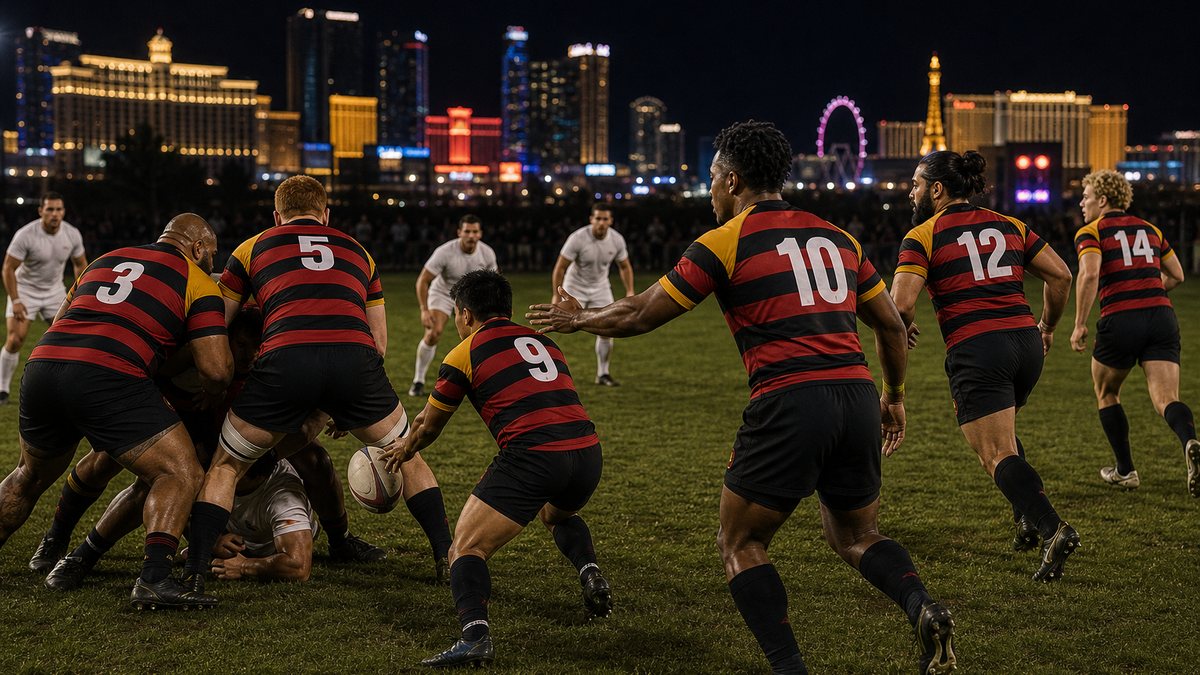
- Union: 15 players, numbered 1 to 15; 8 forwards and 7 backs (World Rugby)
- League: 13 players, numbered 1 to 13; 6 forwards and 7 backs
- Numbering flips: in union the fullback wears 15; in league the fullback wears 1
- Same name, different job: a union "lock" wears 4 or 5; a league "lock" wears 13
- Union bench: up to eight replacements, and a 23-player squad must include six front-row players (World Rugby Law 3)
- NRL bench (2026): six players named (14 to 19), four can be used, up to eight interchanges, first used at the Las Vegas season opener
If you are new to rugby, the numbers on the back of the jersey are the fastest way to understand the game. Each rugby position comes with its own body type, skills and job description, and the two codes, rugby union and rugby league, use different numbering systems for players who often do similar work.
At the Vegas Kings we are home to rugby union and rugby league players alike, so "what position should I play?" is one of the questions we hear most. This guide walks through every position in both codes, number by number, compares them side by side, and finishes with a simple way to work out where you might fit. If you want the bigger picture first, start with our guide to rugby union vs rugby league.
How many positions are there in rugby?
In rugby union, World Rugby's beginner's guide lists 15 positions: "in 15s rugby there are eight 'forwards' and seven 'backs'." Each starting player wears the number of their position, from 1 (loosehead prop) to 15 (fullback). Law 3 of the Laws of the Game says each team has no more than 15 players in the playing area during play.
In rugby league there are 13 positions: six forwards and seven backs. League numbers its team the other way around, starting at the back: 1 is the fullback, 2 to 5 are the outside backs, 6 and 7 are the halves, and 8 to 13 are the forwards.
Shorter formats change the split. World Rugby notes that sevens is played with three forwards and four backs. The APR Games 2027 in Las Vegas is played as 10-a-side rugby; full rules and squad sizes will be confirmed with player registration.
Rugby union and rugby league positions side by side
This table lines up the positions that do broadly similar jobs. It is a guide, not a perfect match: the codes ask different things of players, as the sections below explain.
| Role | Rugby union (number) | Rugby league (number) |
|---|---|---|
| Front-row ball carriers and scrummagers | Loosehead prop (1), tighthead prop (3) | Props (8 and 10) |
| Hooker | Hooker (2): scrum, lineout throw | Hooker / dummy-half (9): plays out of the play-the-ball |
| Tall middle forwards | Locks / second-rows (4 and 5): lineout jumpers | Second-rowers (11 and 12): edge runners and defenders |
| Loose forwards | Blindside flanker (6), openside flanker (7), number 8 (8) | Lock (13): roaming middle forward |
| Main passer from the ruck | Scrum-half (9) | Halfback (7), with the hooker at dummy-half |
| Chief playmaker and kicker | Fly-half (10) | Five-eighth / stand-off (6) |
| Midfield | Inside center (12), outside center (13) | Centers (3 and 4) |
| Wings | Left wing (11), right wing (14) | Wingers (2 and 5) |
| Last line of defense | Fullback (15) | Fullback (1) |
The confusing part is not the jobs, it is the numbers. A league 9 and a union 2 are both hookers. A league 13 and a union 4 are both called "lock" and do completely different work. Learn the role first and the number second.
What do the rugby union forwards do?
The forwards, numbers 1 to 8, are known as "the pack". Their main jobs are to win possession at the set pieces (scrums and lineouts), win and protect the ball at rucks and mauls, and carry hard to get the team over the gain line.
Props (1 and 3)
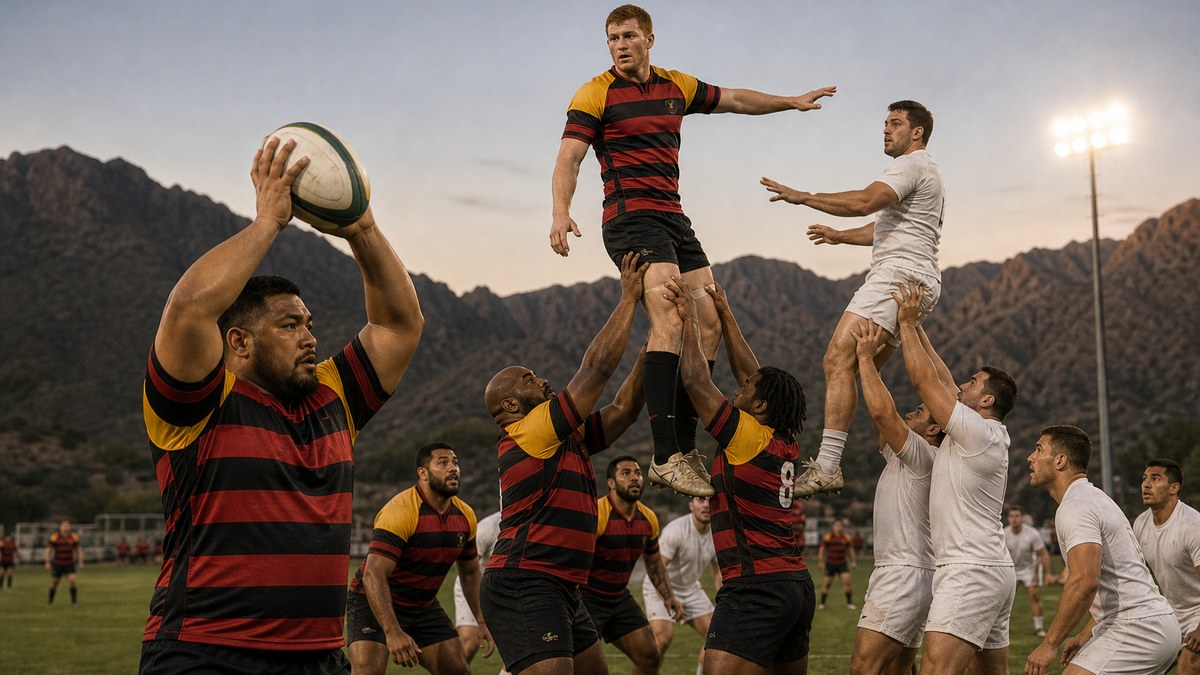
The loosehead prop (1) and tighthead prop (3) sit either side of the hooker in the front row of the scrum. They are usually shorter, very wide and very strong through the neck, back and legs, because they take the weight of two packs pushing against each other. The tighthead has the hardest seat in the scrum, with his head between the opposing loosehead prop and hooker. Away from the scrum, props carry in tight, clear rucks and lift jumpers in the lineout.
Hooker (2)
The hooker sits in the middle of the front row, strikes for the ball with a foot when it is put into the scrum, and throws the ball in at the lineout. Accurate throwing is the skill that separates good hookers from great ones. Hookers tend to be stocky and compact, mobile around the field and strong over the ball at the breakdown.
Locks or second-rows (4 and 5)
Locks bind behind the front row and provide much of the scrum's push. They are usually the tallest players on the field because they are the main jumpers at the lineout and the targets at restarts. They also do a heavy share of the unglamorous work: clearing rucks, tackling and carrying in traffic.
Flankers (6 and 7)
The blindside flanker (6) and openside flanker (7) bind on the sides of the scrum and break away quickly when the ball is won. They are big, athletic, high work-rate players. The openside is often the first to the breakdown, hunting turnovers, while the blindside usually brings more size for carrying, tackling and lineout work. For the detail of that contest, see the Vegas Blackjacks' guide to rugby rucking.
Number 8 (8)
The number 8 binds at the back of the scrum and controls the ball at the base. A number 8 can pick up and carry from the scrum, link with the scrum-half and act as a key ball carrier in open play. It is the only position in union named after its number. World Rugby notes regional names include "eight man".
What do the rugby union backs do?
The backs, numbers 9 to 15, are generally faster and more evasive. Their job is to turn the possession won by the forwards into points, through passing, running lines, kicking and finishing.
Scrum-half (9)
The scrum-half is the link between forwards and backs. They feed the scrum, collect the ball from the back of rucks, mauls and scrums, and pass, run or kick. Scrum-halves are often the smallest players on the field, but they need fast hands, sharp decisions and the confidence to boss bigger teammates. World Rugby lists "half back" as a regional name.
Fly-half (10)
The fly-half is the team's main playmaker. They usually receive the ball from the scrum-half and decide whether to pass, run or kick, so they often control the territory battle and kick goals. In New Zealand the position is known as "first five-eighth".
Centers (12 and 13)
The inside center (12) and outside center (13) operate in midfield. The 12 is often a second distributor and a strong ball carrier; the 13 usually has more space, so pace, footwork and timing matter more. Both have to be excellent tacklers, because midfield is where a lot of attack is aimed.
Wings (11 and 14)
The left wing (11) and right wing (14) play on the outside edges. They are usually the quickest players on the team and the most common try scorers. Modern wings also need to field high kicks, chase their own team's kicks and come off their wing looking for work.
Fullback (15)
The fullback is the last line of defense. They catch kicks, return them, tackle anyone who breaks through, and join the attack as an extra runner. Good fullbacks combine safe hands under the high ball, strong communication and the speed to counter-attack.
Union rewards specialists. A prop who cannot scrummage will be found out in one game, and a hooker who cannot throw costs his team every lineout. If you come to union from league or from another sport, pick a position, master its set-piece job, then build everything else around it.
What do the rugby league positions do?
League has no lineouts and few scrums, and after each tackle the game restarts with a play-the-ball rather than a contested ruck. That changes what each position spends its time doing. With 13 players on a similar-sized field, everyone carries and tackles more often.
Fullback (1)
The league fullback is the last defender and, in the modern game, one of the most important attacking players. Red Bull's 2025 NRL guide describes the fullback as "the voice at the back" who organizes the defensive line, while also inserting into attacking plays as an extra runner.
Wingers (2 and 5) and centers (3 and 4)
Wingers finish tries, but they also do a lot of work at the start of a set, returning kicks and taking hard early carries out of their own end. Centers sit inside the wingers, defend the edges and often throw the last pass. In both codes, these outside backs need speed, strength in contact and good one-on-one tackling.
Five-eighth (6) and halfback (7)
The halves are league's playmakers. The halfback is often described as the quarterback of the team, steering the attack and taking charge of the kicking game, including the last-tackle kick. The five-eighth (called stand-off in England) usually brings more running flair and shares the playmaking load. These are the closest league equivalents to union's 9 and 10, but the decision patterns are different because of the six-tackle set.
Props (8 and 10)
League props do not spend their energy scrummaging. Their job is to "run hard and tackle hard" through the middle of the field, set after set, winning the ruck speed that lets the halves play. Repeat effort fitness is everything here.
Hooker and dummy-half (9)
The league hooker is the main dummy-half: the player who stands behind the play-the-ball, collects the ball and passes, runs or kicks. The hooker is involved in a huge share of plays, so they need quick hands, good decisions and the engine to defend in the middle all game. Any player can act as dummy-half, but the hooker owns the role.
Second-rowers (11 and 12) and lock (13)
Second-rowers usually work on the edges, running strong lines off the halves and defending the wider channels. They are forwards, but more agile than props. The lock, number 13, is a roaming middle forward, a hybrid of prop and second-rower, who may also act as a ball-player. Fullback, five-eighth, halfback and hooker together are often called the team's "spine".
Why do the numbers change between the codes?
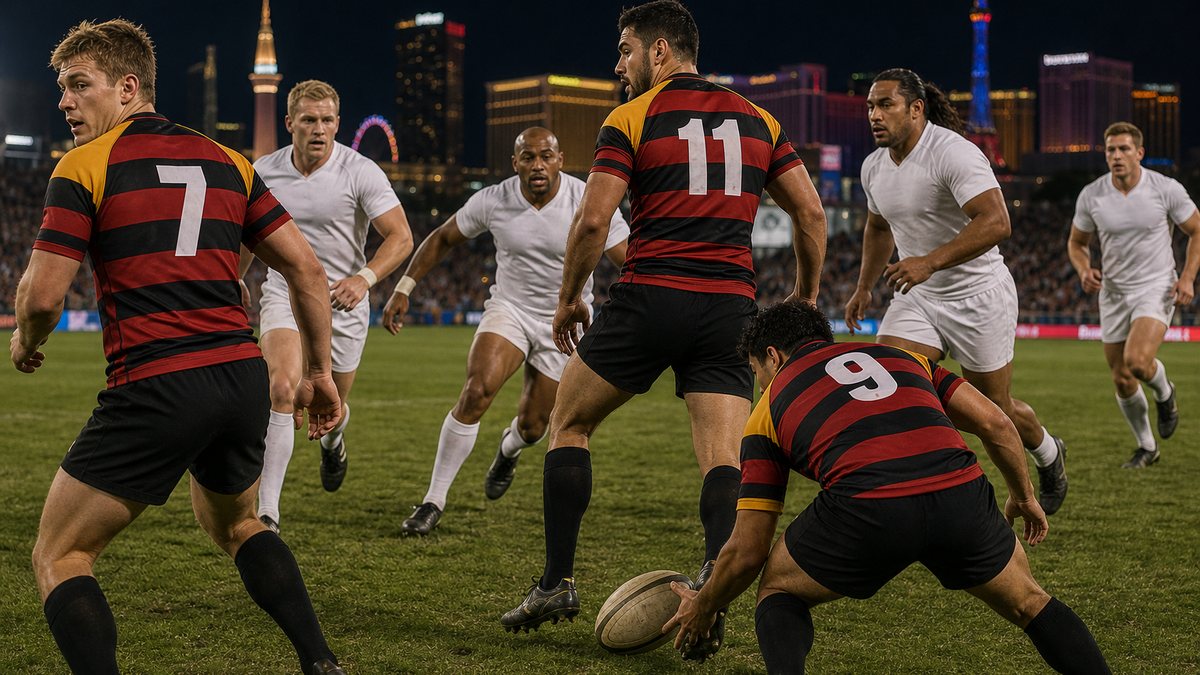
Union numbers its team from the front row backward, so the props wear 1 and 3 and the fullback wears 15. League numbers from the back forward, so the fullback wears 1 and the forwards wear 8 to 13. The positions were named and numbered as the two codes developed separately after the 1895 split, which we cover in our union vs league guide.
There is one more twist. In Europe's Super League, clubs announce squad numbers for the whole season, so a player's shirt number does not always tell you where they are playing that day. In the NRL and in most union competitions, starting players usually wear the number of their position.
How do replacements and benches work?
In union, World Rugby Law 3 allows up to eight replacements. Because the scrum is contested and dangerous without trained players, the law sets minimum front-row cover: a 23-player squad must include six players who can play in the front row, covering loosehead prop, tighthead prop and hooker. If a team cannot field a suitably trained front row, scrums become uncontested. An injured player may not return once replaced.
In league, the NRL changed its bench for 2026. According to NRL.com (4 February 2026), "Teams may interchange four players, up to eight times per match, from a squad of six players (players 14 to 19 inclusive)." Those rules made their NRL debut at the season opener at Allegiant Stadium here in Las Vegas. Bench players are often forwards or a utility who can cover hooker and the halves.
Find your position at the APR Games
The APR Games 2027 in Las Vegas, Memorial Day weekend May 29–31, 2027: 10-a-side rugby, two 20-minute halves, evening kickoffs on three fields. Men's Elite ($10,000 prize pool), Women's Social ($5,000) and Youth divisions. Player entry is $299 and includes a team jersey, a full kit bag, at least three pool games and opening-night access.
Join the APR Games waitlistWhich rugby position is right for me?
There is no perfect formula, and plenty of great players break the stereotypes. But body type, skills and personality are a useful starting point:
- Strong, heavy and love the contact? Look at prop in either code. In union, be ready to learn scrummaging properly under a qualified coach.
- Compact, tough and accurate with your hands? Hooker. In union you will need to master the lineout throw; in league you will be at dummy-half all game.
- Tall and athletic? Union lock, where the lineout is your office, or a league second-rower running edge lines.
- Big engine, love tackling and getting to the ball first? Union flanker or number 8, or a league lock or second-rower.
- Small, quick and like to boss the game? Union scrum-half or league halfback.
- Good kicker and decision-maker? Union fly-half or league five-eighth.
- Fast and like space? Wing or center in either code.
- Brave under the high ball and a good communicator? Fullback.
Most players try more than one position before they settle. If you are completely new to the game, Downtown Rugby's guide on how to start playing rugby as an adult and its rugby rules for beginners are good next reads.
What skills does every position need?
Positions matter, but the basics travel everywhere. Every player in both codes has to catch, pass, tackle and carry. Forwards in modern rugby are expected to handle like backs, and backs are expected to hit rucks and make tackles like forwards.
- Tackling: every position tackles. Tackling is a contact skill, so learn it progressively under a qualified coach and keep the tackle low. The Vegas Knights' guide to how to tackle in rugby safely covers technique and tackle height.
- Carrying: running hard lines and protecting the ball in contact. See the Vegas Lions on the rugby carry.
- Conditioning: league forwards and union back-rowers need repeat-effort fitness, while front-rowers need strength endurance. Our 6-week pre-season conditioning plan works for both codes.
- Set-piece skills: scrummaging, lifting and the lineout throw are union specialist skills. They should only be practiced live with qualified coaching and properly matched players. The Blackjacks' guide to the rolling maul shows how lineout work feeds into the pack's attack.
Every week, American Pro Rugby's free newsletter, The Breakdown, breaks down one skill and a strength block you can run.
Some of the best code-switchers we see are league backs who move into union's back three and league back-rowers who become union flankers. The hardest switch is the front row, where union's scrum asks for skills league never trains. Whatever your number, the gold standard is the same: master the job the number gives you.
Positions in Las Vegas rugby
Las Vegas is a good place to learn both codes. Rugby League Las Vegas returns to Allegiant Stadium on Saturday 27 February 2027, which gives local fans a close look at how NRL and Super League teams use their spines and benches. Our Rugby League Las Vegas 2027 guide has the full weekend. Coming in for it or for the APR Games? APR partner Luna Appleton covers where to stay, eat and celebrate in the city.
If you like tracking your own stats by position, tackles, carries and work rate, APR's tech partner Vibe Coding covers how people build simple apps of their own. For team gear, visit the APR merch store, and to see who else is building rugby in the city, meet all the APR teams.
Frequently asked questions
How many positions are there in rugby union?
There are 15 positions in rugby union: eight forwards (two props, a hooker, two locks, two flankers and a number 8) and seven backs (scrum-half, fly-half, two wings, two centers and a fullback), numbered 1 to 15.
How many positions are there in rugby league?
Rugby league has 13 positions: a fullback (1), two wingers (2 and 5), two centers (3 and 4), a five-eighth (6), a halfback (7), two props (8 and 10), a hooker (9), two second-rowers (11 and 12) and a lock (13).
What is the hardest position in rugby?
There is no official answer. Many coaches point to tighthead prop in union because of the scrum, and hooker in league because of the workload at dummy-half. Every position has its own demands.
What does a hooker do in rugby?
In union the hooker (2) strikes for the ball in the scrum and throws in at the lineout. In league the hooker (9) usually plays at dummy-half, collecting the ball from the play-the-ball after each tackle and passing, running or kicking.
Is a lock the same in union and league?
No. In union, locks wear 4 and 5 and are tall second-row forwards who jump in the lineout. In league, the lock wears 13 and is a roaming middle forward who carries, tackles and sometimes plays as a ball-player.
Why does the fullback wear 15 in union but 1 in league?
Union numbers its team from the front row backward, so props wear 1 and 3 and the fullback wears 15. League numbers from the back forward, so the fullback wears 1 and the forwards wear 8 to 13.
What is the equivalent of a fly-half in rugby league?
The five-eighth (6), also called stand-off, is the closest equivalent, sharing the playmaking with the halfback (7). In New Zealand, the union fly-half is also called first five-eighth.
How many replacements are allowed in rugby union?
World Rugby Law 3 allows up to eight replacements. A 23-player squad must include six front-row players who can cover loosehead prop, tighthead prop and hooker. If no trained front row is available, scrums become uncontested.
How big is an NRL bench in 2026?
From 2026, NRL teams name six interchange players (numbers 14 to 19), and any four of them can be used, with up to eight interchanges per match, according to NRL.com.
What position should a beginner play?
Start with your body type and strengths: big and strong often suits the front row, tall suits lock or second row, quick suits the backs. Try several positions in training and learn contact skills under a qualified coach before settling.
Keep reading
Sources
- World Rugby: Beginner's guide, players and positions (February 2021)
- World Rugby Laws of the Game, Law 3: Team (accessed November 2026)
- NRL.com: New rules to create exciting new role for young stars (4 February 2026)
- Zero Tackle: NRL confirm rule changes for 2026 (4 February 2026)
- Red Bull: NRL positions, the complete guide (29 April 2025)
- Rugby league positions (Wikipedia, accessed November 2026)
- Love Rugby League: Super League 2026 squad numbers, club by club
- American Pro Rugby: APR Games 2027
Laws and competition rules change over time; this guide reflects World Rugby's Laws of the Game and NRL rules as published at the time of writing (November 2026). Rugby is a contact sport: learn tackling, scrummaging, lifting and other contact skills progressively under a qualified coach, and check your competition's current laws before you play.